Development brief
What to include in a knit outerwear development brief
A clear starting brief for brands with a complete tech pack or an early design reference.
A useful development brief does not have to settle every design decision before the first conversation. It does have to distinguish what the brand has approved, what is a visual reference, and what the supplier must check or develop. For a zip-knit outerwear style, that distinction matters at the front opening: a drawing can show a clean line without specifying the zipper function, length, tape appearance, knitted edge or sample version. Send one current brief with a decision owner for each open point, then ask for a project-specific feasibility response.
On this page · 7 sections
- Name one garment and one design version
- Separate known measurements from fit direction
- Describe the knitted body without inventing a finished specification
- Give the zipper its own decision line
- Put approvals and unknowns on the same sheet
- Add the buying context without turning it into a promise
- A concise first message
Name one garment and one design version
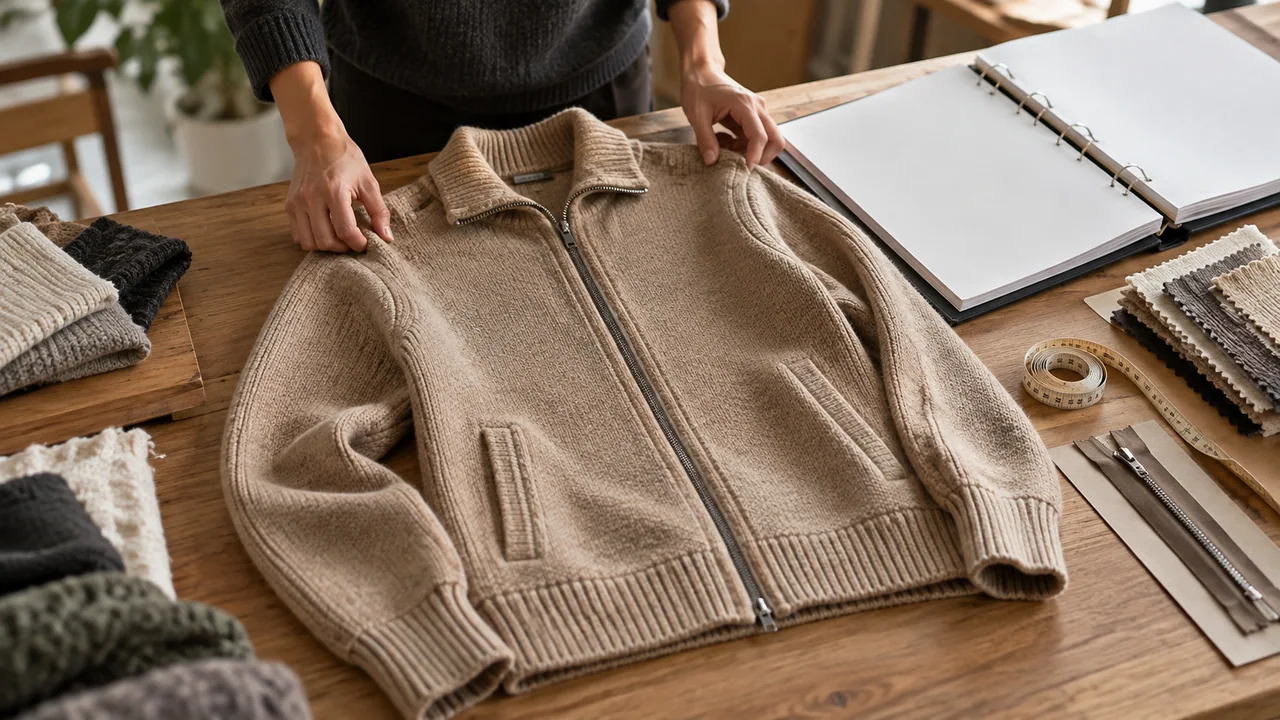
Begin with the garment's purpose and intended wearer: for example, a full-zip layering cardigan for an autumn capsule or a more structured knit jacket. State the target fit in plain words and identify the base size. Front, back and side references are useful, but label each image as a concept, an existing physical garment, or a detail reference from another style. A collage of several jackets is not one approved design. If you borrow a collar from one image and a pocket from another, mark those choices on a single current view.
Give the brief a version code and date. Keep the original reference files, then list what changed in the new version. This prevents the team from quoting one front view while sampling a later pocket or collar. Our concept-view reconciliation guide covers image conflicts in more detail; this article is about the minimum decision record to send for development, including material, measurement and commercial inputs.
Separate known measurements from fit direction
Supply a measurement sheet if one exists. For each point, name the measuring location, unit, base size and whether the value is fixed or provisional. Body length, chest width, shoulder, sleeve, collar height and hem width may all affect a zip-front jacket, but the appropriate points depend on the intended shape. A generic size label such as “medium” is not a substitute for the brand's base-size measurements. If measurements are still open, send a fit reference garment or clear fit direction and ask what the sample quotation includes for developing them.
Write down the condition in which the measurements will be checked. The first garment may be measured after its agreed finishing process; any later wash or care assessment needs its own agreed method and acceptance criteria. Do not copy a tolerance from an unrelated fabric or assume that one photographed sample establishes a graded size run. The zip-front sample review guide explains how to compare a named sample with the approved specification after it arrives.
Describe the knitted body without inventing a finished specification
If yarn composition, gauge or stitch construction is fixed, provide the source record and the required value. Otherwise describe hand feel, appearance, intended season, stretch, weight direction and any non-negotiable fibre restriction. Add close views of the body knit, rib, collar, cuff and pocket area. A gauge number alone does not determine the garment's weight, drape or finished dimensions; the yarn, structure and finishing also matter. Ask the supplier which material and construction options are feasible for this design and quantity.
Use one material-status label per component: “brand approved”, “supplier proposal requested” or “awaiting physical sample”. A generated concept image can convey the shape and colour direction. It cannot verify fibre content, stitch density, colour match or that a depicted sample exists. Keep proposed materials separate from any final approval record.
Give the zipper its own decision line
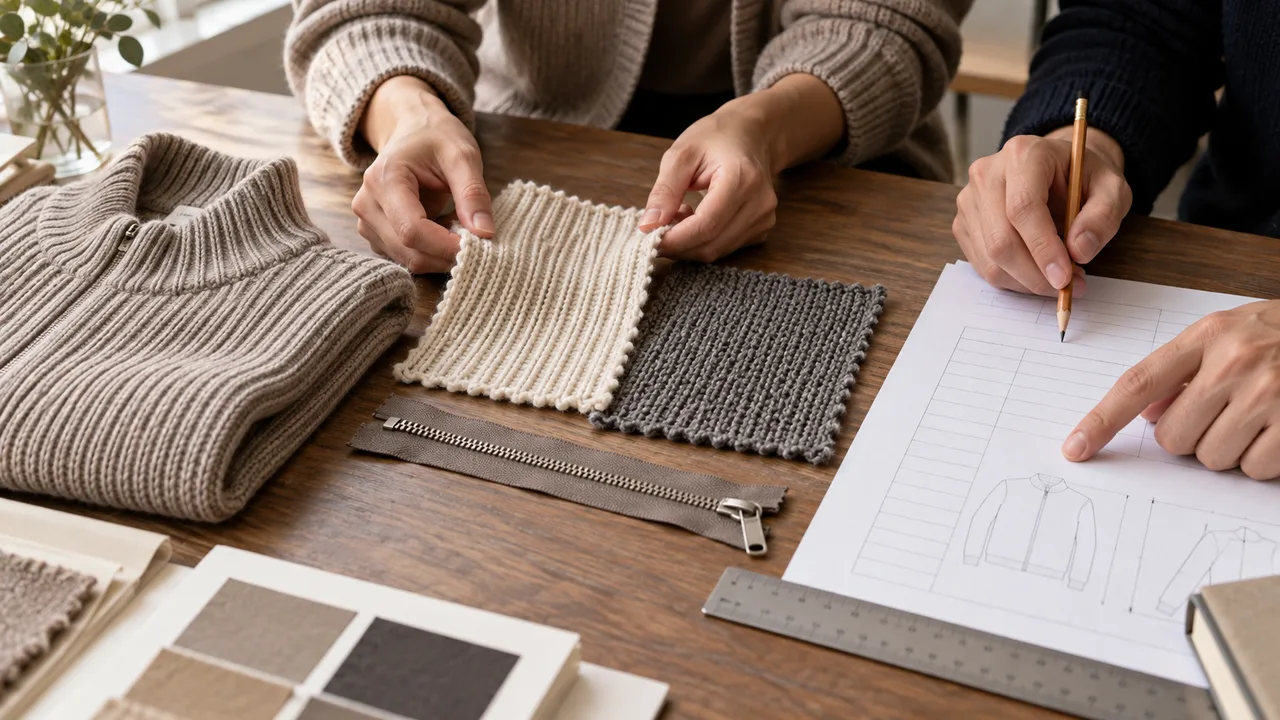
"Add a zip" leaves several visible and functional questions unanswered. Mark whether the garment needs a full opening, a shorter opening or another construction; whether the zip should separate at the bottom; and whether a two-way function or pocket zip is being considered. Show the intended position, approximate opening length, collar and hem relationship, tape visibility, colour direction and puller treatment. If the brand nominates a particular zipper, attach the maker's actual reference; if not, ask for a proposed component subject to approval. A YKK manufacturer product table distinguishes closed, open and two-way configurations as external terminology; it does not mean Licheng uses that product or that a nominated part is available or suitable for this garment.
Do not treat the length shown in an AI image as a measurement. If the correct length depends on the final size block or collar construction, mark it provisional and ask how the sample will resolve it. Likewise, a smooth front in a render is not evidence that the chosen tape and knit edge will sit flat. Our opening-type brief treats zipper selection in greater detail; the initial development brief only needs to make the unresolved choice visible.
Put approvals and unknowns on the same sheet
The following small matrix can travel with a concept image or a full tech pack. It is a buyer worksheet, not a claim that one sample has been tested or that Licheng has a fixed approval service.
Swipe sideways to read all columns →
| Decision | What the buyer sends now | What remains to confirm |
|---|---|---|
| Silhouette and fit | Current front/back references, wearer, base size and fit direction | Physical sample version and final measurement sheet |
| Yarn and knitted parts | Fibre or hand-feel target, colour reference, close views | Feasible yarn, stitch, sample swatch and approval method |
| Front opening | Full or short opening, desired function, visible tape and puller direction | Nominated component, length and knit-edge treatment |
| Branding and packaging | Artwork version, label locations and intended pack format | Production-ready artwork, component availability and quoted scope |
| Quantity and timing | Pieces by style, colour and size; intended review and ship-ready dates | Applicable MOQ, sample start, bulk start and delivery terms |
An item can remain open when the brief is sent. The useful response is a list of feasible options, evidence needed, cost or timing effect and the person who will approve the choice. If the supplier proposes a substitution, keep that proposal alongside the original brief rather than silently editing history.
Add the buying context without turning it into a promise
Give approximate pieces per style and colour, a planned size range, target market, packaging/branding requirements, destination and the date by which a sample decision is needed. Distinguish a target launch date from a required factory ship-ready date. A target cost can be shared if it is a real development constraint, but it should not be presented as an agreed unit price. Ask the supplier to state what its quote includes: yarn search, swatches, garment sample, zipper and label sourcing, revision rounds, testing, shipping and any artwork work. What is outside the quote should be visible too.
If you have no complete pack, send the current concept plus the matrix above and request a feasibility discussion. If you already have a detailed pack, ask which lines still need material or construction confirmation. In either case, the MOQ and schedule guide explains why sample and bulk clocks begin at different milestones; do not calculate a guaranteed delivery date from a generic article. Pricing, minimums and timing are confirmed for the selected materials, quantities and order conditions.
A concise first message
An initial request could read: “We are developing one full-zip knit jacket in two colours for an autumn range. The attached front/back concept is version B; the collar and pocket positions are fixed, while yarn composition and zipper supplier are open. Our base-size measurements are attached, with three points marked provisional. Please assess feasible knit and zipper directions, state what a first sample quote includes, and identify the approvals needed before you can quote bulk timing. Approximate quantities by colour and our destination are in the worksheet.” This is an illustrative brief, not a customer order or an accepted Licheng project.
Before sharing artwork or customer-owned designs, remove unrelated personal data, confirm permission to use the references and mark confidential files. Send only what is needed to assess the project. A clear list of fixed and open decisions gives the team something useful to answer without pretending that the concept image is already an approved production specification.