Zip specification
How to Brief an Open-End, Two-Way or Pocket Zip on a Knit Jacket
A pre-sampling worksheet for brands choosing where a knit jacket or pocket should open, marking garment endpoints and confirming the selected trim supplier's length convention.
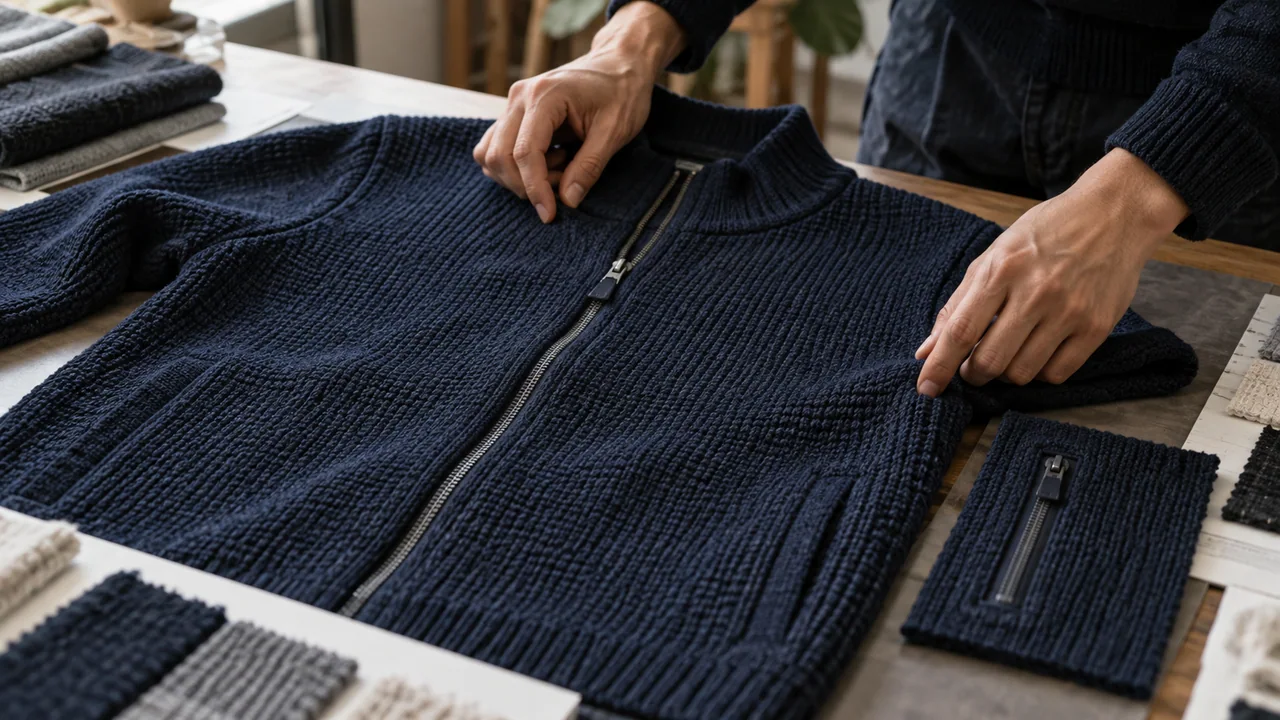
A sketch of a zip-front knit jacket can look complete while leaving a basic question unanswered: what needs to open, and where should the opening stop? A centre front that must separate at the hem, a front that should also open upward from below, and a zipped pocket are three different requests. They should not be compressed into “use a full zip” on a tech pack.
On this page · 4 sections
This worksheet helps a brand mark those decisions before sampling. It is not a component specification for an existing Licheng reference style. The factory and the selected trim supplier must confirm which construction can be sourced and how its length will be measured for the actual project.
Start with the opening's job
For a jacket front, decide whether the two garment fronts need to separate completely. If they do, ask for an open-end proposal and mark the intended connection point at the hem. If the wearer should be able to release the front upward from the bottom while it remains connected above, describe that use case and ask whether a two-way open-end arrangement is appropriate. YKK's explanation of two-way zippers distinguishes a separating jacket-front arrangement that can open from either end from two-way closed arrangements that do not separate. Do not assume that a photograph of two pulls proves how the finished garment opens or that a two-way option will be available in the chosen material, size, colour and quantity.
A pocket is a separate decision. Mark the mouth of the pocket and whether it needs to close at both ends; do not specify the pocket zip by copying the centre-front end arrangement. YKK's general wearables guide distinguishes open-end or two-way open-end jacket fronts from commonly closed-end jacket pockets. That is an example of component functions, not a promise that Licheng stocks or uses YKK for a particular style.
Swipe sideways to read all columns →
| Location in the drawing | Question for the buyer | Mark before the first quote |
|---|---|---|
| Centre front | Must left and right fronts separate at the hem? | Top position, lower connection point and a front view in the base size. |
| Centre front with possible lower release | Why should the wearer open it from below, and how far? | Intended worn use, lower opening view and whether two-way operation is essential or optional. |
| Pocket opening | Should the opening remain joined at both ends? | Pocket-mouth start and end, opening direction and a view showing access with the garment worn. |
The table records the garment design request. It does not choose a zipper model, slider or strength rating. Put an unresolved item in an “open decision” column rather than turning it into an assumed approved part.
Mark garment positions before ordering a zipper length
On a dimensioned front drawing, give the base size and units. Mark where the visible opening should start and finish on the garment: the intended collar or neckline position, hem position, and any pocket-mouth limits. Add a close view when a folded placket, rib hem, facing or guard could hide the actual end hardware. A photograph alone may show the look but cannot establish the ordered trim dimension.
Now make a second field for the supplier's zipper dimension. These are related but not automatically the same measurement. YKK's zipper instruction manual, section 1-2 uses different measurement endpoints for closed-end, open-end and two-way open arrangements and illustrates separate tape extensions. Its diagrams are useful proof that an end type changes the measuring question; they are not a universal rule for another supplier or a tolerance for a Licheng garment. Ask the nominated supplier to identify its exact dimension endpoints and any required tape extensions for the selected part.
Keep the two dimensions together in one record:
- Garment target: base size, drawing version and the marked upper and lower visible positions.
- Proposed trim: end type, supplier and part reference, with the supplier's own measurement diagram or written endpoint convention.
- Assembly allowance: how the collar, hem, placket and pocket construction place the hardware relative to those garment positions; to be proposed by the sample team.
- Decision owner: who will compare the proposed part with the assembled sample and approve a change if the positions or component change.
Do not take a nominal zip length from an older jacket and assume it works after changing the base size, collar height, hem depth or opening type. If the drawing is revised, update both the garment target and the trim request before treating a prior quote as current.
Keep the front and pocket decisions separate at sampling
At sampling, compare each marked opening decision with the actual garment. For an open-end front, record where the lower connection sits against the hem mark and whether the two sides separate as requested. If lower release was specified, show how far it opens from below and record whether that feature was retained or removed. For the pocket, compare the actual mouth endpoints and access while worn with the drawing. Identify the physical sample version for each view, and list any mismatch by location before approving a component change.
This is a function and placement review for one garment, not a strength, wash or production-lot test. The insertion pin, box and knitted hem deserve their own detailed review after the opening type has been agreed. For broader fit, care and final sample sign-off, use the separate zip-front sample review guide.
A short buyer brief to send
Add a zip-opening supplement to the general knit outerwear development brief: mark centre-front and pocket endpoints, the reason for lower release, and whether two-way operation is essential or optional. State the base size and approximate quantity by style and colour so component feasibility can be checked. Label any undecided part or dimension as “for supplier and sample review.” If you nominate a trim supplier, include the exact part and its dimension convention; otherwise ask what can be sourced and quoted for this garment.
The quotation and sample approval can then refer to the same opening type, garment positions and component version. If any of those changes, ask for a revised decision before bulk production. To discuss an actual project, send the marked drawing and open questions in a project brief. Availability, assembly, pricing, timing and the sample review method are confirmed for the specific garment.