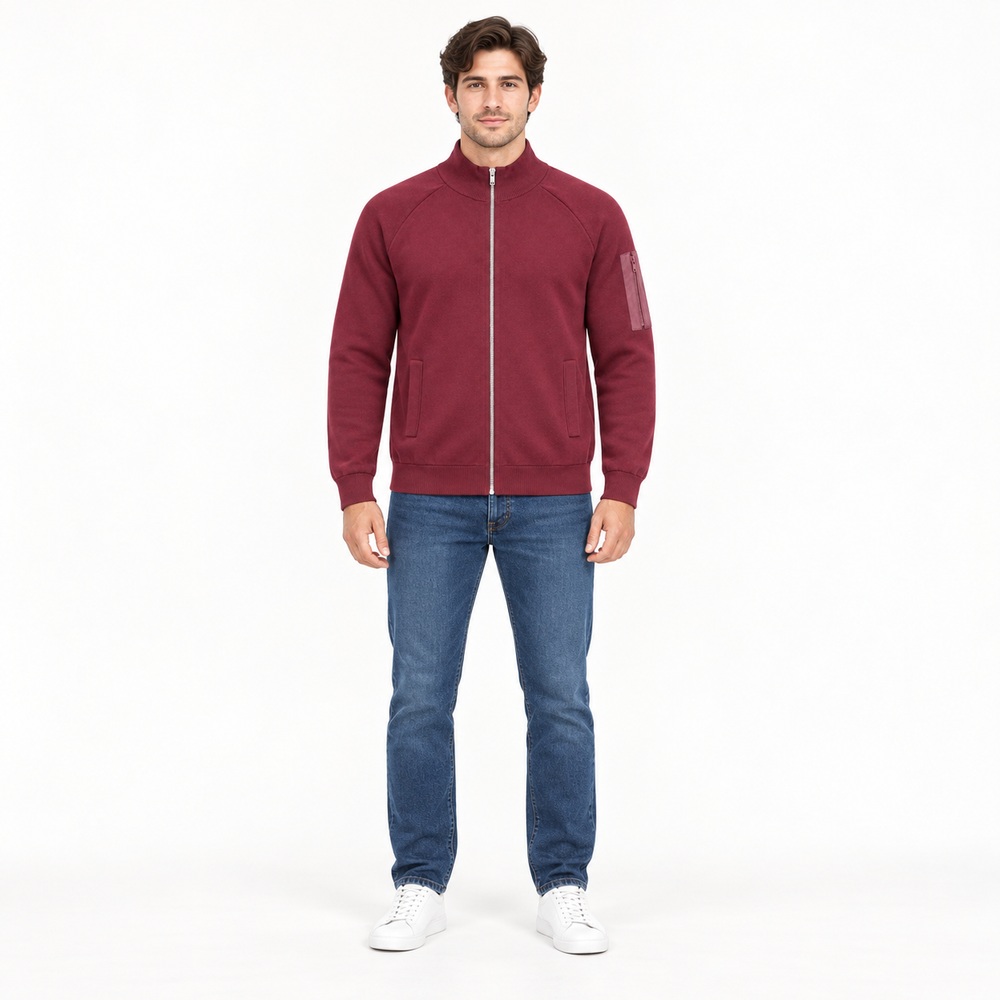
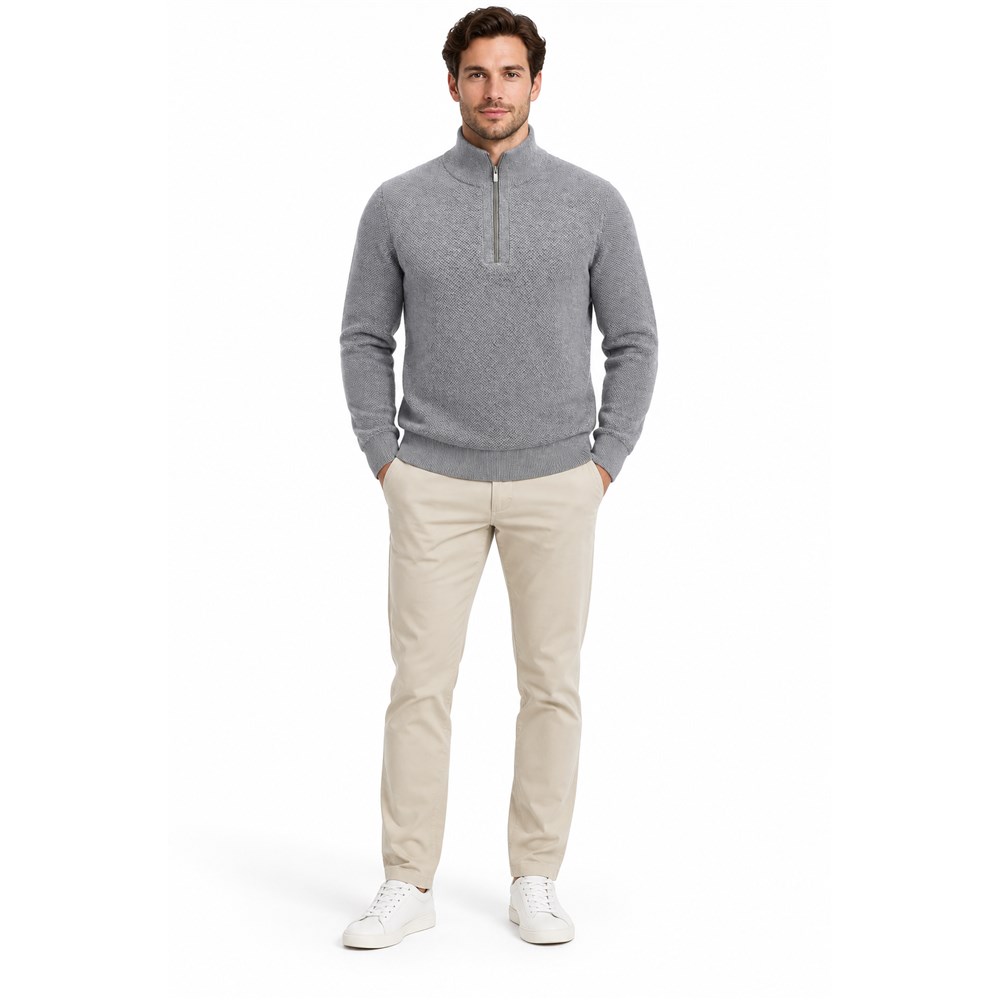
Sample review
How to review a zip-front knitwear sample
A practical approval checklist covering the front opening, fit, washing conditions and the trim specification.
Approve a zip-front knitwear sample only against a named physical garment, a written brief and agreed observations. Look at the same version flat, on the intended wearer or form, and while the zipper is operated. Record what is accepted, what needs another sample and which questions remain open. A catalogue image or an isolated zipper close-up cannot establish the fit, front balance or performance of that garment.
Leave the review with one clear decision.
- Identify one garment and its current brief.
- Compare the flat, worn and operated front.
- Record the observation and requested change.
- Keep accepted details separate from unresolved ones.
On this page · 8 sections
- Start with one identifiable sample
- Review the front in three complementary views
- Separate a fit issue from a construction issue
- Agree the operating and care conditions
- Close the decision with a version record
- Copy a review record for your own sample
- Write a revision request the sample team can act on
- Choose the next step for your project
This buyer guide is a planning method. It is not a laboratory test method or evidence that any Licheng reference style has passed these checks. The acceptance criteria, component, care method and sample scope belong in the actual project agreement.
Start with one identifiable sample
Put the sample ID, revision date, base size and intended wearer or form at the top of the review record. Attach the current front and back drawing, target measurements with units, yarn and knit construction direction, nominated zipper reference, pocket placement and trim/branding details. Mark any field that is still undecided. Do not silently fill gaps from a product photograph.
Use one revision for the entire review. If the front view is from sample A, the worn view from sample B and the zipper close-up from a trim supplier, those pictures cannot together approve sample C. Keep the files named so a reviewer can tell which garment, size and component each observation belongs to.
Review the front in three complementary views
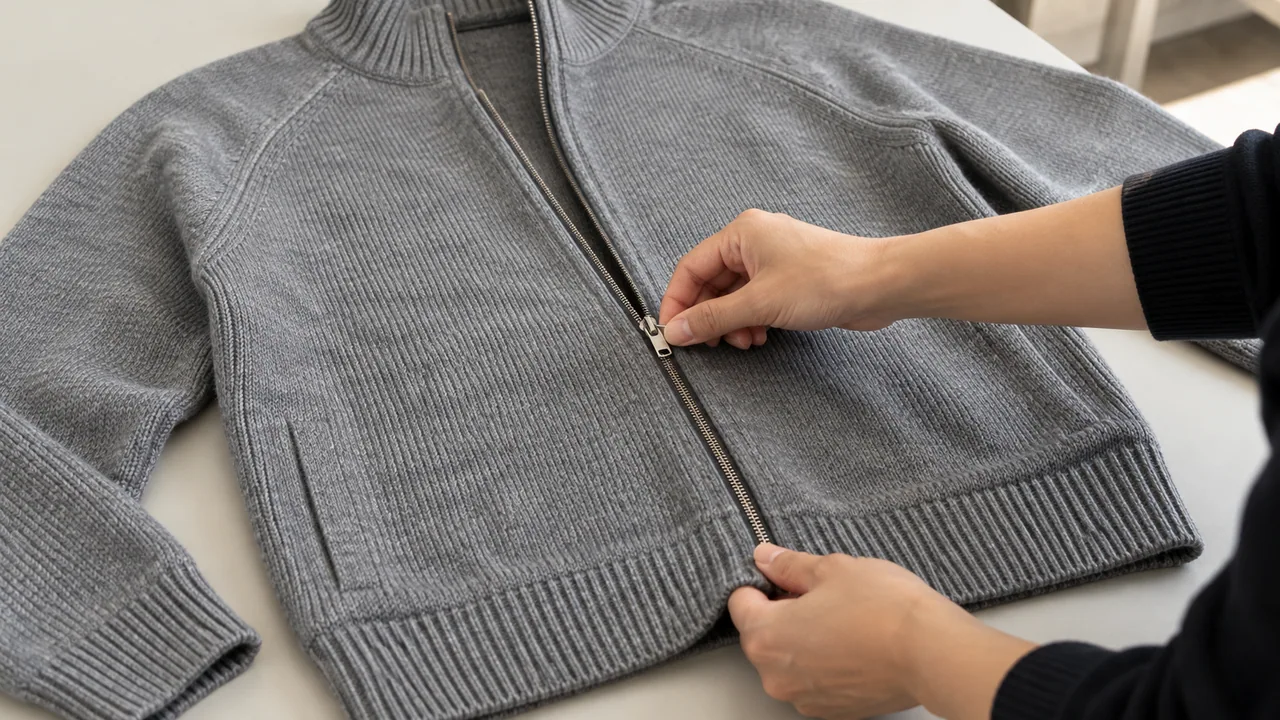
The same front can look balanced while lying flat and pull to one side when worn. A zip may also run freely off the garment but be awkward at the assembled hem. Request three comparable views before deciding which change is needed:
Swipe sideways to read all columns →
| View | What to observe | What it cannot prove alone |
|---|---|---|
| Flat, closed and open | Front-edge alignment, collar, pocket positions, rib and hem meeting points | Worn fit, ease of starting the zipper, or behaviour after care |
| Worn or on the intended form | Silhouette, front tension, drape and whether the hem rides or twists | The cause of a problem without the construction record |
| Zipper operated on the garment | Starting, closing, reopening and clearance around knit, facing and pockets | Long-term durability or compliance with an unspecified test |
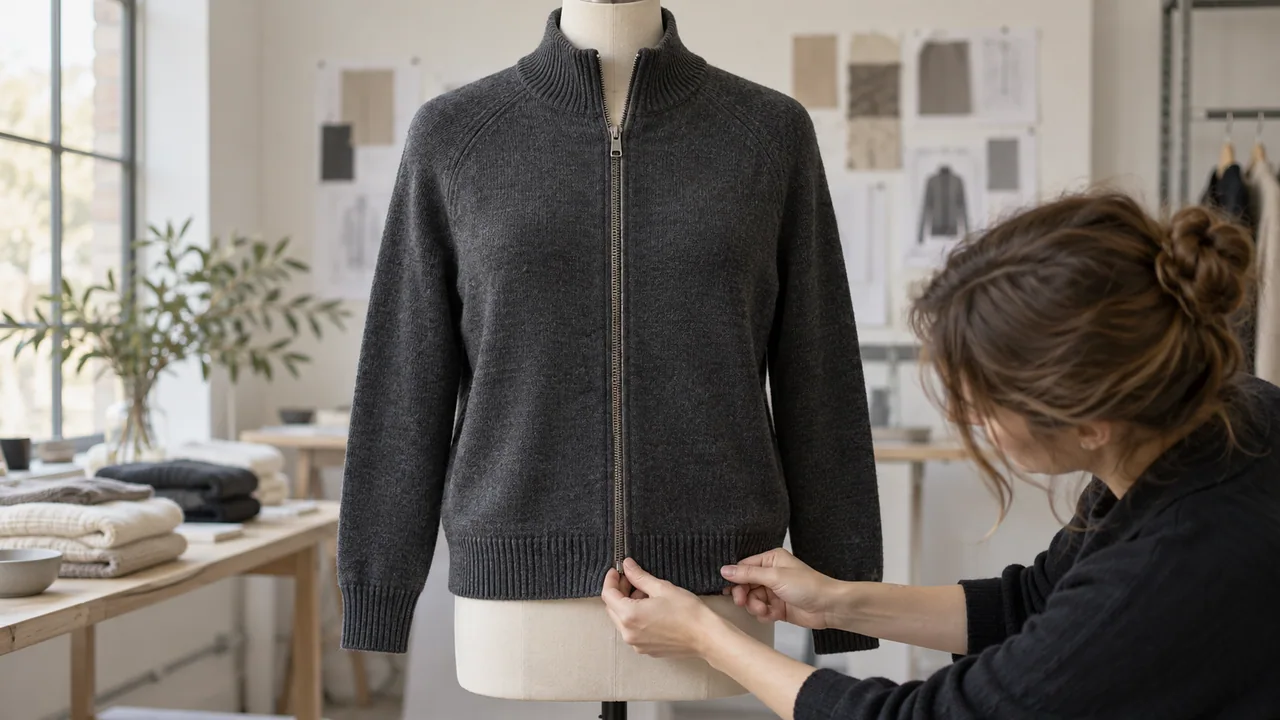
Keep camera angle, garment size and handling comparable when showing a revision. Include one full-front view so a close-up has context. If the image does not show a decision point clearly, ask for another view rather than inferring the unseen construction.
Separate a fit issue from a construction issue
Write the observation before proposing a cause. For example, “the left front edge moves upward when closed on the base-size form” is more useful than “the zipper is wrong.” Compare the current measurement sheet and the two front panels, then ask the sample team whether the source could be the fit, rib depth, tape position, seam treatment, component or handling. A single photograph cannot settle that diagnosis.
When requesting a change, record the target result and the specific part to revise. If body width changes, recheck its relationship to front opening length and hem alignment. If the nominated zipper changes, keep its supplier reference, length convention, colour and opening type with the revised sample; do not approve an unnamed substitute just because it looks similar. For the lower connection of a separating zip, use the more focused open-end lower-box review.
Agree the operating and care conditions
Ask the sample team to demonstrate the selected component in accordance with its supplier instructions. Observe where a hand holds the garment, how the slider starts, whether the knit or facing enters the path, and whether either side is pulled out of shape. Write down the step and location of any hesitation. This is an observation for investigation, not a universal pass/fail number.
If a wash or care review is required, agree the actual method, measurement points, conditioning and comparison conditions before it is carried out. Preserve the before-and-after measurement record for that construction and colour. Do not transfer the result from one yarn, sample, colour or care route to all later production. Any formal tolerance, repeat count or durability requirement needs a project-specific method and acceptance agreement.
Close the decision with a version record
Swipe sideways to read all columns →
| Decision | Record to keep | Next action |
|---|---|---|
| Accepted | Sample ID, drawings, measurements, nominated trim, dated views and unresolved exceptions | Confirm what the approved version controls for quotation and bulk planning |
| Revise and review again | Exact observation, requested change, owner and new sample ID | Compare the revised garment in the same relevant views |
| Cannot decide yet | Missing measurement, component reference, care condition or clear image | Request the missing evidence before sign-off |
If several changes are proposed at once, ask for one consolidated revision list. A buyer should be able to open the final record later and see which garment and trim were approved, not assemble an implied approval from email fragments or mixed photographs.
Copy a review record for your own sample
Keep the following fields beside the garment during the review. Use the same record for the full-front image, detail views and written feedback. Fill in the buyer's agreed requirement before adding an observation; a blank requirement is a question to resolve, not permission to assume a tolerance.
Swipe sideways to read all columns →
| Review field | Fill in for this sample | Why it belongs in the decision |
|---|---|---|
| Sample identity | Style / revision / date / size / colour | Keeps feedback attached to the garment actually examined. |
| Reference requirement | Drawing section or measurement point / units / agreed condition | Shows what the buyer and sample team are comparing. |
| Current observation | What changed, where it appears and when it happens | Separates an observation from a proposed technical cause. |
| Supporting views | Full-front view plus the matching detail or operation view | Keeps a close-up connected to its garment. |
| Proposed action | Keep / revise / request more evidence | Makes the next step visible without treating silence as approval. |
| Re-review owner | Person responsible / requested response date / next sample revision | Prevents an unresolved item disappearing between messages. |
For a full-zip cardigan, include the front both open and closed so the two front edges can be compared. For a half-zip pullover, include the collar open and closed and ask to review the opening depth and access over the head. These are different garment functions; the lower connection of a separating full zip is not a check to copy automatically onto a closed-end half zip.
Write a revision request the sample team can act on
An illustrative observation might be: "On the identified base-size sample, the hem sits level while open but one front edge rises when closed on the intended wearer." That describes what the buyer sees.
- Reference the sample ID and the exact full-front and detail views.
- State the agreed appearance or measurement you are comparing against.
- Ask the team to review the observation and propose a correction; do not prescribe an unverified cause.
- Request the same views and relevant measurements on the revised sample.
- Record which other features remain accepted and which need to be checked again after the change.
If the review happens remotely, use the same-sample evidence guide to organise the files. A useful review can finish with a precise request for missing information; it does not need an unsupported pass or fail.
Choose the next step for your project
If you have only a design image, start with a development brief. If you have an existing Licheng catalogue style in mind, ask the team to confirm the current sample route and the changes you need. If you already have a physical sample with an issue, send the sample identity, agreed brief and observations from that same garment.
Licheng's published development starting point is USD 150 per style, 15–25 days. Ready sample timing is about 7 days from a ready style or yarn already in house. These are different starting routes; confirm availability, the work included and project timing before proceeding. Send the sample questions you need resolved.