Order planning
How Can a Buyer Compare Two Zip-Knit Jacket Quotes on the Same Brief?
A side-by-side worksheet for checking zipper assemblies, knit construction, sample scope, quantities and delivery terms before comparing unit prices.
Two factories may quote the same sketch of a zip-front knit jacket and return different unit prices. Before choosing one, ask a more useful question: did they price the same garment and the same responsibilities? A line that says “metal zip included” may refer to a complete open-end front assembly in one quote and a different end type, supplier or finish in another. A quotation can also omit pocket zips, a revised sample or the buyer's nominated labels while still looking complete at first glance.
Make the scope comparable before the price.
- Use the same garment and revision.
- Match yarn, closures and quantity split.
- Separate development charges and extras.
- Align delivery scope and resolve unknowns.
On this page · 7 sections
- Freeze one reference before asking for two prices
- Build a comparison sheet that exposes differences
- Work through a difference before requesting a revised quote
- Keep sampling and bulk conditions separate
- Compare the project total without hiding unknown costs
- Compare the delivery basis precisely
- Send one consolidated clarification request
This worksheet helps a brand mark matched, changed or unknown beside each commercial and product assumption. It is a request for comparable written answers, not a claim that Licheng has seen two actual quotes for a particular style. Neither the lower number nor a generic industry price range proves which factory can make the approved garment.
Freeze one reference before asking for two prices
Send both suppliers the same dated brief: one style and revision, intended wearer and size range, target fit, yarn composition or performance direction, knit construction, colourways, quantity by colour and size, packaging, destination and delivery window. Identify which decisions are fixed and which alternatives may be proposed. If there is only a reference image, call it a development brief and ask each supplier to list the assumptions behind its price; do not label it a fully specified garment.
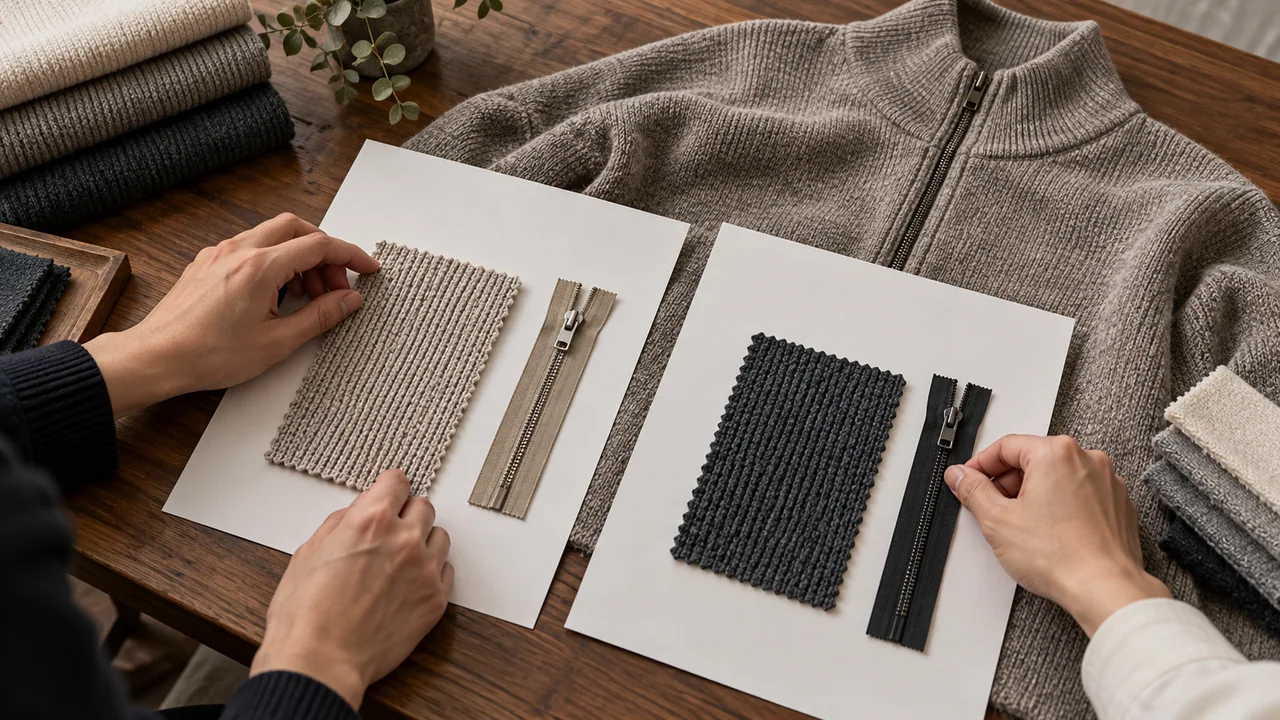
For the front opening, name the required function: full open-end, two-way or closed-end. State the visible positions of upper and lower ends on the garment. Ask each supplier to quote its proposed complete assembly, including supplier and part reference if selected, chain, tape, slider, pull, end arrangement, colour or finish, and how its quoted length is measured. If the jacket also has pocket or sleeve zips, name their count and function separately. A front zip price does not necessarily include every additional closure on the sketch.
The zip-front sample review guide explains how the assembled garment is reviewed. At quotation stage, record which construction and component each supplier proposes to sample; no photo of a reference style confirms a component has already been nominated or tested for your order.
Build a comparison sheet that exposes differences
Copy the blank columns below for your project. Enter the exact answer from each written quote, then mark match, different, or unknown. Do not fill an unknown with what seems customary.
Swipe sideways to read all columns →
| Same-brief check | Supplier A's written offer | Supplier B's written offer | Buyer action |
|---|---|---|---|
| Style revision, base size, fit and measurement basis | ___ | ___ | Confirm both priced the same version. |
| Yarn, knit structure, gauge direction and finishing | ___ | ___ | Request a stated alternative where different. |
| Front zipper assembly and installation; separate pocket-zip count | ___ | ___ | Identify every included closure and nominated part. |
| Colour route and quantity by style, colour and size | ___ | ___ | Ask how minimums and any separate colour costs apply. |
| Sample fee, included revision rounds and buyer approval point | ___ | ___ | Separate development cost from bulk unit price. |
| Testing, labels, packing and document requests | ___ | ___ | List inclusions, exclusions and items priced later. |
| Currency, unit basis, trade term, named place and delivery window | ___ | ___ | Match the commercial basis before comparing totals. |
| Quote validity and conditions for a changed specification | ___ | ___ | Know when a re-quote is required. |
The table is intentionally empty. It does not imply that either supplier offers a particular zipper, test or service, or that every item must be bundled into a unit price. If one quote names a nominated branded assembly and the other offers an unnamed alternative, record that as a specification difference, not an unexplained price saving. Decide whether the alternative is acceptable and ask for a revised written price on the same basis.
Work through a difference before requesting a revised quote
The examples below are hypothetical scope differences, not actual supplier offers or prices. Use them to decide which written answer is still needed before the two prices can support a purchasing decision.
Swipe sideways to read all columns →
| Difference in the written offers | What remains unresolved | Useful next question |
|---|---|---|
| The yarn compositions differ | The garment specification is not aligned. | Can you quote the nominated yarn separately from your proposed alternative? |
| One price lists the front zip but does not mention the pocket closures | The included trim count is unknown. | Which complete closures and installation operations are included? |
| The colour or size split differs | The production quantity basis is not aligned. | Can you revise the price against the attached colour-by-size allocation? |
| One development fee includes a stated revision and the other has no revision scope | The sample services cannot yet be compared. | What does the fee cover, and what is charged separately if a revision is requested? |
| Delivery is quoted to different named places | The delivery tasks and costs differ. | Please state a matching named place and delivery basis, with exclusions listed. |
Keep the original answer and the revised answer tied to their quote dates. A cheaper alternative can be worth reviewing, but changing the yarn or closure should be a deliberate product decision rather than an invisible change inside a price comparison.
Keep sampling and bulk conditions separate
A sample quotation may include development, one physical garment, trim sourcing or a specified number of revisions. A bulk quotation may rely on an approved sample, material availability and a fixed quantity. Ask what triggers each timeline and payment, whether extra samples or colour approvals are separate, and whether a sample fee is credited if an order follows. Do not add a sample fee to one supplier's bulk price while leaving the other supplier's development work out of the comparison.
The second site's planning guide treats sampling and bulk as separate decisions. For a side-by-side comparison, show a project total that lists one-time development charges, unit price at the requested quantities, nominated extras and delivery costs under the same assumptions. If a field remains conditional, show it as conditional. There is no honest single “cheapest quote” calculation when a required component or service has no price yet.
Compare the project total without hiding unknown costs
Once the scope is aligned, show four lines separately: bulk units multiplied by the quoted unit price; one-time development charges; explicitly quoted extras; and delivery costs on the agreed basis. Use the same currency and quantity split in both columns. Show any relevant excluded cost as excluded or awaiting a price rather than entering zero.
Do not divide a one-time sample fee across one supplier's order and leave it out of the other supplier's comparison. Equally, do not assume that a sample fee will be credited against production unless that condition is written in the offer. The purpose is an explainable comparison of this project, not a universal price benchmark.
For Licheng's current quantity starting point: 50 pieces per colour. Plain and striped styles using the same yarn and colour may be combined; sizes may be mixed. Jacquard/intarsia: 50 pieces per pattern, with no combining different patterns. If the brief uses more than one yarn, colour or pattern, include that allocation and ask the team to confirm how the condition applies. A single total quantity is not enough to settle the colour and pattern split.
Compare the delivery basis precisely
Ask for the currency, quoted quantity, named trade term and named place in each offer. ICC's Incoterms® rules explain that trade terms allocate delivery tasks, costs and risks between seller and buyer. A quoted garment price with one delivery basis cannot simply be compared with another price that includes a different transport scope. Request an aligned version or list the additional costs and responsibilities separately. The purchase agreement still needs its own product, payment and acceptance terms.
Send one consolidated clarification request
You can adapt the following short structure instead of sending a sequence of unrelated price questions:
- Brief reference: style, revision date, intended fit and the nominated yarn/closure requirements.
- Quantity allocation: units by colour and size; identify shared yarn/colour or separate patterns where relevant.
- Difference to resolve: the exact row in the comparison sheet, quoting the supplier's current answer.
- Revised offer requested: an aligned specification and quantity, named delivery basis, quote validity, sample scope, extras and exclusions.
Attach the same brief to both requests and ask suppliers to label any alternative separately. If the uncertainty is now about the physical garment rather than the quotation, move to the zip-front sample review before giving production approval. Ask Licheng to review your brief and quantity split.